Purpose

This independent blog collects news about projects or achievements in regulatory reform / better regulation. It is edited by Charles H. Montin. All opinions expressed are given on a personal basis.
Background on regulatory quality, see "Archive" tab. To be regularly informed or share your news, join the Smart Regulation Group on LinkedIn: 1,300 members, or register as follower.

Showing posts with label Regional. Show all posts

14 November 2013

New RIA resources (APEC/Mexico)

The Mexican Federal Regulatory Commission ( COFEMER ) and Asia-Pacific Economic Cooperation Forum (APEC ) held in Mexico City, on 7 and 8 November, their third Workshop on "Final Guidance and Capacity Development Programme for Regulatory Impact Assessment " (available from COFEMER.)
The purpose of the workshop was to share experiences and best practices in regulatory reform, contributing to improving the competitiveness and well-being of the economies of the Asia -Pacific region. The workshop brought together civil servants from various countries in the Asia - Pacific region, including Chile, South Korea, Philippines, Indonesia, Malaysia, Mexico, Peru, Russia, Thailand and Vietnam, and international experts. The workshop approved the final version of a guide for assessing the impact of regulation, to which is appended a volume of case studies, and a joint training programme to enable knowledge transfer to regulators and government officials in the participating economies.
This was the third and final workshop of the APEC - Mexico Project "Development and implementation of methods to improve the quality of regulation and Regulatory Impact Assessments," aimed at increasing the openness of markets, transparency and economic growth.

15 May 2013

Doing Business in EAC 2013

Released 2 May, "Doing Business in the East African Community 2013" takes stock of the impact of regulatory reforms in this area which has registrered significant positive economic development. Rwanda remains the best pupil in the class of 5 economies, but Burundi jumped 10 places in the world ranking thanks to several key reforms. New data show the importance of access to regulatory information. The rise in e-government initiatives in the region (as in other parts of the world) provides an opportunity to increase access to information and transparency. The report finds that "The EAC has achieved greater convergence in the complexity and cost of regulatory processes than in the strength of legal institutions relevant to business regulation."

18 September 2012

Regulatory "coherence" helps regional economic integration (APEC)


In a previous post (November 2011) this blog reported action by APEC to strengthen good regulatory practices, following the the Honolulu declaration, to assist member economies establish closer economic and trade relations.
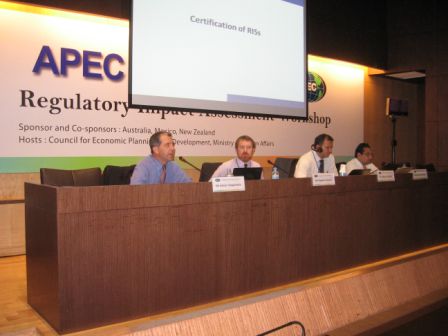
In 2012, under the general objective of reinforcing "regulatory coherence" as listed as a priority in the Honolulu declaration, APEC implemented a capacity building project to conduct regulatory impact analysis (RIA) training for APEC developing economies. The project, developed by Australia, and co-sponsored by Australia, Mexico, New Zealand and the Russian Federation, involved a series of training courses and workshops in interested developing economies, aimed at senior economic ministry and regulatory officials. For background, see 2011 NZ proposal to APEC. The first training course was provided by the Australian Office of Best Practice Regulation, with assistance from Mexico and New Zealand, to approximately 60 Russian officials on 9 and 10 February in Moscow. Subsequently, New Zealand provided training to Thailand and Malaysia, Mexico provided training to Chile and Peru, and Australia provided training to the Philippines. In the last two weeks of August, Australia, New Zealand and Mexico jointly provided training to Hong Kong and Chinese Taipei (see attached photo), and conducted an information exchange with China. Australia and New Zealand then conducted a workshop on regulatory impact analysis in Vietnam. For a more recent expression of this APEC policy, see Kazan (Russia) meeting of APEC ministers in charge of Trade (June 2012).

23 July 2012

ASEAN holds first RR symposium

Today ASEAN convened its first Regulatory Reform Symposium (ASEAN ARRS) as part of ongoing efforts towards regional economic integration by 2015. The invitation by the Philippine to host the ARRS was accepted during the 20th High Level Task Force on ASEAN Economic Integration meeting in Jakarta last year. The symposium aims to identify key challenges in policy formulation and address the gaps to achieve a more comprehensive regulatory reform program for specific sectors and industries.
Both supply chain connectivity and logistics are heavily affected by regulations that cut across the integration pillars. The region works to set up a single market and production base, a competitive economic region, equitable economic development, and integration into the global economy by 2015.

26 January 2012

Regulatory reform in Africa (OHADA)

For a good update on regulatory reform efforts in mostly francophone Africa, a newly released IFC/ World Bank “report, “Doing Business in the OHADA 2012”, draws on data from the annual global Doing Business study and takes a detailed look at business regulations in the 16 OHADA economies.
Founded in Mauritius in 1993, OHADA is a system of business laws and implementing institutions adopted by 16 West and Central African nations. OHADA is the French acronym for "Organisation pour l'Harmonisation en Afrique du Droit des Affaires."
The average ranking of the OHADA member states is 166 out of the 183 economies measured in the global Doing Business 2012 report. Mali, with a global rank of 146, is the easiest place among OHADA member states for an entrepreneur to do business, followed by Burkina Faso (150) and Senegal (154). In the past six years, all 16 OHADA member states made it easier to do business. Across the region, the average cost of starting a business decreased from 338 percent to 110 percent of the average per capita income. The average time required to register property also decreased by 28 percent.
The importance of international trade for all economies makes it worthwhile to pool information with a view to improve national and regional competitiveness.
One of OHADA's priorities is to establish a uniform legal framework to govern business activities in the region's economies, hence making the region more attractive to FDI and foreign business. This year, the first revision of the body of commercial laws in the region simplified business entry in eight member states and strengthened secured transaction laws in all 16 member states.

01 December 2011

European regions ponder smart regulation

With all eyes on the new Belgian government constituted after a record inter-regnum, how could we not signal that Flanders has just uploaded proceeds of the conference announced on this blog, which invited officials from regions of European countries to reflect on "How do Flanders and the other European regions cope with the competency for smart regulation in a multilevel environment?" Representatives from Wales, Lombardy, Scotland and Flanders presented their regional policy of smart regulation and discussed with OECD, EC and the Committee of Regions how they could interact with the smart regulation central strategy. The other Belgian region (Walonia) seems not to have been present. A pity neither German lander, nor Spanish communities (for a study of their regulatory work see a previous post), attended. (For more information see also post on Commitee of Regions multi-level governance and better regulation.)

18 November 2011

ASEAN pursues regional regulatory dialogue

As reported in the international press (example Thailand), on 17 November 2011, ASEAN held its 19th ASEAN Summit in Bali, Indonesia, followed by a meeting with the ASEAN Business Advisory Council (ABAC). Key issues discussed at the Summit were ASEAN Community building by 2015 (see the Blueprint), the role of ASEAN in the global community and other regional and international issues of mutual interest.
At the end of the Summit, ASEAN Leaders signed a Bali Declaration on the ASEAN Community in the global community of nations and witnessed diverse technical agreements.
Regulatory reform remains high on the agenda to achieve regional integration, and is most visible in the third pillar, which calls for streamlining standards and technical barriers to trade including systems of standards, quality assurance, accreditation and measurement. Leaders called for the institutionalisation of the High-level Task Force on Regulatory Reform, whose first meeting was held in Jakarta on Aug. 3, 2011 (as reported on this blog.) For more on this event, see an article in Jakarta Post.

15 November 2011

APEC promotes good regulatory practices

In complement to yesterday's post about the APEC ministerial, our network correspondent in Chinese Taipei, who was at the conference, draws our attention to the APEC Leaders' Honolulu Declaration ("Towards a seamless regional economy) published yesterday. Go to Annex D "Strengthening Implementation of Good Regulatory Practices" to see how member countries will try "to embed the concepts of non-discrimination, transparency, and accountability into the regulatory cultures of APEC economies", to help create jobs and promote economic growth. Experts will want to check the new formulation of principles of high-quality regulation contained in that document. Compared to the new OECD principles, which are now close to finalisation and publication, the APEC text provides a shorter and more general list of actions to be implemented by November 2013. On substance, there is little new in this document (except perhaps the notion of "incentives to review regulation") but we can hope that it will create some momentum for domestic reform in member countries.

14 November 2011

APEC links RR with trade and green growth


There is a lot of conceptual material to be found in the proceedings of the 2011 APEC ministerial meeting held in Honolulu, Hawai, on 11 November and chaired by Ms Clinton. In a “Declaration of Honolulu – towards closer regional economic ties,” APEC Ministers committed to take action to strengthen economic integration and expand trade, promote green growth and advance regulatory convergence and cooperation, to achieve economic growth in the region. The statement published on the APEC site and the annex F on regulatory issues provide rich reading. Here are the main chapters (our unofficial summary):
  • "Regulatory Cooperation on Emerging Standards and Regulatory Issues for green growth": the objective is to prevent unnecessary technical barriers to trade, support interoperable emerging standards for smart grids, green buildings, and solar technologies.
  • Approval of a "Regulatory Cooperation Action Plan" to inter alia improve the efficiency and effectiveness of regulations, build public trust in regulations, improve consumer confidence in globally traded products and encourage implementation of the APEC-OECD Integrated Checklist on Regulatory Reform;
  • Regulatory Convergence: streamlining approval procedures for Medical Products , harmonised classification of Chemicals, cataloguing regulations on Services, reducing unnecessary testing and streamlining paperwork on Wine certification and trade procedures, raising common Food Safety rules, including closer alignment on international standards (with APEC-World Bank collaboration).
In summary, a fine example of effective regional regulatory cooperation.

11 September 2011

ASEAN starts regulatory reform dialogue

Among many reasons for engaging in international regulatory cooperation, regional economic integration is certainly one of the most promising in terms of competitiveness and growth potential. After devoting a decade (2000-2010) to applying Better Regulation principles to its legal production, the European Union has refined its tools under the name of smart regulation. Other regions are following, as already reported on this blog, including South East Asia and East Africa.
In South East Asia, regional integration took another step forward, as delegates met for the First ASEAN Regulatory Reform Dialogue (ARRD) in Jakarta on July 27. Here are excerpts from the official report online:
“The Dialogue - chaired by Dato Lim Jock Hoi, Permanent Secretary, Ministry of Foreign Affairs and Trade of Brunei Darussalam -is an important avenue to exchange views and information on regulatory reform efforts and policy measures, and to discuss measures and activities to take forward ASEAN initiatives on regulatory reform related issues.
This effort is a positive and pro-active step towards looking into ways to deal with impediments to trade, and investment facilitation, as ASEAN advances its economic integration.
Specialists in structural and regulatory reforms from the World Bank, and the Asia-Pacific Economic Cooperation (APEC)Secretariat, also shared their knowledge, tools, approaches and experiences at the Dialogue.
In today's complex and interconnected world, regulations assume a greater role than ever before as a fundamental tool of government, and an integral part of a well-functioning economy. Regulatory reform is a multi-faceted task that involves various stakeholders, and it requires co-operation between all levels and all stakeholder groups in ASEAN, namely government administration, business, and peoples.
Dato Lim said that "ASEAN is diverse and there is no 'one size fits all' formulation to addressing regulatory reform . but there is scope for a degree of regulatory coherence in many areas, especially in areas committed under the ASEAN Economic Community (AEC) Blueprint". He further elaborated that "undertaking regulatory reform will never be an easy task and it is essential to start the process of socialising the issue of regulatory reform within ASEAN today".
The Deputy Secretary-General of ASEAN for ASEAN Economic Community, S. Pushpanathan, who participated in the Dialogue, articulated that "behind the border regulatory reform could assist ASEAN countries in realising the full potentials and benefits of trade, investment liberalization, and facilitation at the border." He further added that, "for a successful regulatory reform to take place, it is important that we bring in the private sector and other stakeholders to participate in the regulatory reform and policy-making process".
During the Dialogue, each ASEAN country presented the progress, challenges and issues related to regulatory and structural reform that has and is being undertaken in the areas of trade in services, investment facilitation and transport. The Members then exchanged views on their respective reform efforts and discussed on the possibility of cooperation in these three areas at the regional level.”

Philippines: one-stop-shop with ASEAN dimension

An article published today by a Philippines Online Journal draws attention to a seemingly advanced system to simplify business red tape. The National Single Window (NSW) was set up by a Presidential Executive Order and allows a single submission and accelerated processing of applications for licenses, permits and other authorizations required prior to undertaking a trade transaction. It already serves as a link between 40 Agencies and their public. See their very informative site.
But what is really special about this single window is its international dimension: it stems from the agreement to establish an ASEAN Economic Community (AEC) by 2015 whose mission is to develop a single market and production base that is stable, prosperous and highly competitive and economically integrated with effective facilitation for trade and investment, thereby forming the ASEAN Single Window (ASW). The ASEAN Single Window is the environment where NSWs of member countries operate and integrate. Activities include exchange of information of ASEAN Customs Declaration Document and Certificate of Origin under the Common Effective Preferential Treatment (CEPT) scheme of ASEAN Free Trade Area (AFTA). The impetus for these reforms is supported by regular meetings of the ASEAN Regulatory Reform Dialogue (see last meeting on 27 July 2011).
A 2009 short report, published by APEC, presumably as a spin-off of the OECD-APEC Cooperative Initiative on Regulatory Reform, draws a comprehensive picture of achievements and shortcomings of Regulatory Reform in the Philippines.

21 June 2011

Sub-Saharan Africa attracts FDI

According to a report by Kenyan paper Business Daily, a reduction in red tape and an improvement in political conditions means that sub-Saharan Africa is becoming a more attractive destination for foreign direct investment, especially from India. This theme was highlighted at a conference organised by the South African Institute of International Affairs where experts from India and Africa examined ways of deepening engagement between South-South economies.The South African Institute of International Affairs (SAIIA) is highly attuned to Regulatory Reform issues and publishes reports focusing on ways to improve the business climate, with detailed studies on NTBs. Its site also promotes the African Peer Review Mechanism, an interesting tool for the 21 members (2006 figure) to work together to implement reforms to achieve better governance and consolidate democracy. A conference will be held on 28 June by SAIIA to monitor progress of APRM in Southern Africa.
For background on RR in Africa, see paper by IFC coordinator P. Ladegaard and the proceeds of the Mombasa meeting of the Network of Reformers (already summarized on this blog).

01 June 2011

EU- USA regulatory dialogue

The EU - USA regulatory dialogue is a topic not yet covered by this blog, but well worth checking out for its technical content. A DG Enterprise webpage traces the history and goals of the dialogue (since 1998), launched on the basis that "Regulatory barriers have long been recognised as the most significant impediment to trade and investment between the EU and the USA... a more integrated and streamlined transatlantic regulatory environment would significantly reduce costs for producers and consumers on both sides of the Atlantic and improve the competitive potential of EU and US companies in the global economy." Both the European Union and the United States run a number of regulatory dialogues.
The EU-USA dialogue takes a practical turn at the meetings of the High Level Regulatory Cooperation Forum, which is convened at irregular intervals, and where partners discuss burning trade issues but also exchange best practice concerning regulatory reform methodologies or compare notes on current issues (example reponses to the financial crisis.) For an example of proceedings, see report of the 2008 meeting in Washington).
The framework agreement has spawned more specialised streams, such as the the financial markets regulatory dialogue (for EC point of view see 2004 paper) which aims to foster a better mutual understanding of EU and US regulatory approaches; to identify potential conflicts in approach as early in the regulatory process as possible; and to discuss regulatory issues of mutual interest. Other sectoral dialogues (15) include Automotive industries, Chemicals, RTT and Insurance.
Recent news: owing to the interests at stake, the dialogue is lively: yesterday, Commissioner for internal markets and services Michel Barnier was putting pressure on his US counterparts, according to a Financial Times news item. Mr. Barnier stated that even though the pair had jointly declared their commitment to introduce a number of regulatory initiatives, the EU has overtaken its counterpart in areas such as capital requirements and putting curbs on banker bonuses. "The level playing field must be a reality, not an empty slogan," he is reported to have written in the letter, sent on 27 May. Mr. Barnier's concerns rest with the US's reluctance to fully adopt banking standard Basel II, fearing that the country could take a similar stance with its successor, Basel III.

17 March 2011

EU and ASEAN join forces on regional economic integration

At the close of a seminar on regional economic integration earlier this month, a joint communiqué from EU and ASEAN announced the official launch of revamped cooperation between the two organisations, in the ASEAN-EU Economic Integration Support Program (AEISP). This new instrument succeeds the Programme for Regional Integration Support (APRIS Phases I and II) and aims in particular to assist the establishment of the ASEAN single market and production base by 2015. APRIS Phase I and Phase II have been operating for the last eight years with EU grant support of €10 million. The new programme has expanded targets and can draw from a larger budget of $20.7 million.
These goals are to be sought via actions similar to those undertaken by the EU to build its Internal Market, which relies to a large extent on Better Regulation principles and results, including the simplification of customs procedures across borders, harmonization of administrative documents, standardization of technical requirements and the transition from governmental pre- approval system to a post-market surveillance.
The programme also requires improving dispute settlement mechanisms.

07 February 2011

BR supports EAC regional integration

Your blogger attended a P2P learning event in Mombasa last week where the five countries of the East African Community, joined by neighbouring states (Zambia, RDC) and OHADA, shared ideas and exchanged best practices about building the Common Market launched in 2009 between Kenya, Uganda, Tanzania, Rwanda and Burundi. The Investment Climate Advisory Services of the World Bank Group, organiser in partnership with Kenya and donors, had placed the event under the banner of Regulatory Reform and invited experts from the EU and ASEAN to draw lessons from these more integrated groups on how to apply RR principles to manage regulation, harmonize national commercial laws, monitor implementation of reform by the use of scorecards and efficiently inspect enforcement.

All material will soon be online (URL so be communicated here), following the two previous events in Arusha 2008 (on cutting red tape) and Kampala 2010 (multi-level). Participants also gave updates about their respective RR projects and results and called for the development of a regional set of regulatory quality standards similar to the OECD ones. See also press report.

16 January 2011

Single Market: time to act ! conference

BR experts should be interested in this conference, which will take place in Brussels on 8 February.
There is a full dossier (COM(2010)608, press release, background material) online, to get an overview of how the old Common Market (1956) is being "relaunched," following the Monti report and other updates.
Also worth reading are the conclusions of the Competitiveness Council (10 Dec 2010) on the same page. There are several references to better and smart regulation (especially paragraph 17): RIAs, admin burden reduction are also relaunched, with ex-post evaluation and fitness checks naturally included. There are many reasons why the internal market needs rejuvenating: still too much fragmentation, emergence of the digital economy, challenges of globalisation. The aim is to build a competitive social market economy. Citizens and consumers to be placed at the heart of the single market.
According to  the invitation, the conference "will provide an opportunity to exchange ideas with MEPs, the EU Presidency, governments, regional and local authorities, stakeholders, the academic community, think tanks and media active on European issues. The conclusions of this event will enrich and complement the debate, allowing the Commission to take account of different views when proposing the definitive action plan for the relaunch of the Single Market in spring 2011."

07 December 2010

Uganda launches regulatory reform

Last week, Uganda launched a regulatory reform programme with World Bank support. According to the press release, the reform program will focus on reducing regulatory costs and risks associated with obtaining business licenses, and on simplifying and reducing taxes for small and medium enterprises. Uganda’s legal and regulatory regime is cited as one of the biggest challenges constraining the country’s private sector. A recent World Bank Group study of Uganda’s business licensing regime puts the annual private sector regulatory compliance costs at $175 million per year, which represents 1.3 percent of the country’s GDP.
Uganda is not alone in this venture: regulatory reforms are pursued across the region and are boosted by the adoption in November 2009 of the Common Market Protocol, which should lead to measures to ease doing business and harmonised laws that guarantee the region's competitiveness to help its economies are to surpass the current level of investments.
In a follow up to last year's peer-to-peer reformers meeting in Arusha, the World Bank Group convened another meeting in Kampala recently to assess progress and how much ease has been created for businesses to operate in the region.
The Bank's experts say the region now requires more business-friendly regulation and faster legislation of business laws, preferably handled by the region's parliament. Reforms are also needed in tax payment systems, land registration and business licensing.
This work is supported by the Investment Climate Advisory Services of the World Bank Group which helps governments implement reforms to improve their business environment, and encourage and retain investment, thus fostering competitive markets, growth and job creation. Funding is provided by the World Bank Group (IFC, MIGA, and the World Bank) and over fifteen donor partners working through the multi-donor FIAS platform

01 December 2010

Viet Nam's commitment to administrative reform

We all know how much good regulatory management can bring about a better environment for investment and business, and is therefore particularly relevant in developing and transition countries seeking higher rates of growth. But knowing it and acting on it are two different things. Among the countries having resolutely adopted a regulatory reform agenda, we should single out Viet Nam, where sustained efforts to reform the public administration since the 1990s under the responsibility of the Home Affairs Ministry, have recently taken on a regulatory reform dimension. An interministerial Special Task Force was set up in 2007 to implement a large scale “administrative procedure reform.” Several foreign aid agencies supported the effort, among which USAID with its Viet Nam Competitiveness Initiative, AusAID and others.
The simplification of administrative procedures is well underway with “Project 30” having already delivered a full inventory of existing procedures, accessible online to citizens and business in a “national database” and two batches of simplification measures compiled after the officials applied the Regulatory Guillotine TM of Jacobs and Associates.
Other regulatory reforms instruments are also in the pipeline, such as the introduction of RIA, codification, electronic portals for business procedures (managed in each major city) and one-stop shops. An agency in charge of controlling the quality of new regulation according to the new principles has just been setup.
To take stock and evaluate achievements and plan further policies, the government of Viet Nam invited OECD to assess Project 30 and recommend options for a regulatory reform strategy. The report was presented at the first ASEAN-OECD workshop on regulatory reform, in Hanoi on 25-26 November. This major event, co-hosted by Viet Nam as chair of ASEAN and the OECD, was attended by some 15O Vietnamese officials and representatives from 6 other ASEAN countries. It was widely reported in the press, with official press releases from the Vietnamese Communist Party and the Government showing that this is a priority policy.
Many of the measures planned still need to be implemented, and the economic effects of the reforms have yet to be measured, but in the meantime, there is no doubt about the current government’s determination to cut red tape and reform public administration.

12 November 2010

OECD and ASEAN cooperate on regulatory reform

Regulatory reform, under the denomination of Better Regulation, has greatly contributed to European economic integration. Has its potential been recognized and tapped in other regional groups? While the Asia-Pacific countries (associated in APEC) have been discussing BR since 2000, the South East Asia countries started more recently, in 2007. In both cases, these groups tapped OECD experience and exchanged best practices with its member states.
The APEC countries recognized that regulatory reform contributes efficiently to the promotion of open and competitive markets, and can be a key driver of economic efficiency and consumer welfare. As a result, APEC and OECD agreed a Co-operative Initiative on Regulatory Reform in 2000 and jointly issued in 2005 an Integrated Checklist for self-assessment of regulatory, competition and market openness policies, to build domestic capacities for quality regulation.
More recently, the ASEAN countries have engaged a similar dialogue with OECD since 2007. To date, ASEAN and OECD have organised two regional forums to strengthen cooperation between the two organisations:
A seminar on Challenges in Cooperation and Communication for Development in Southeast devoted to “Aid Effectiveness & Regional Economic Integration Asia” was held on 26-27 April 2010 in Hanoi, Viet Nam.
Other joint-activities include “ASEAN Special Dialogues with the OECD” in October in Paris and the coming “ASEAN-OECD South East Asia Investment Policy Conference” 18 -19 November 2010 in Jakarta. Preparations are also underway for the joint collaboration on the “Southeast Asian Economic Outlook Report” in 2012.
Regulatory reform has been identified as a specially promising tool to bring about greater economic integration and competitiveness. At their meeting in August 2010 in Da Nang, the ASEAN economic ministers agreed to an “ASEAN Regulatory Reform Dialogue” at the senior economic officials’ level early next year to address some of the issues starting with trade facilitation, services liberalization and investment facilitation.
In the meantime, as announced by Secretary General of the OECD, the Organisation will co-host the first ASEAN-OECD meeting on regulatory reform in Hanoi on 25-26 November.