(Yonhap press release) "The Australian Embassy in Seoul on Friday (13 March) hosted a forum on regulatory reform and deregulation with the South Korean government in a bid to explore ways for cooperation in these areas, officials said.
The one-day forum titled the "Best Practice Regulation Workshop" came as Seoul and Canberra seek to boost cooperation in the field of regulatory reforms with a free trade agreement between South Korea and Australia (KAFTA) going into effect late last year.
"Services and investment are important parts of KAFTA, but they cannot reach their full potential unless the regulatory environment improves," Bill Paterson PSM, the Australian ambassador to Seoul, said at the opening of the forum.
"Predictability, transparency, consultation, consistent application, and cutting red-tape are essential and both our governments are committed to achieving a more business friendly regulatory environment," he added.
Kang Young-chul, deputy minister for regulatory reform, also said that "drastic reform is necessary for the success of regulatory reforms," adding that South Korea and Australia will continue to carry out cooperation in this sector.
South Korea said that it will scrap more than 100 administrative rules cited by local companies for hindering businesses as it seeks to prod more companies into increasing investment to jump-start the local economy.
Australia is in the process of reducing tape worth $1 billion every year in its drive for deregulation, the embassy said."
Showing posts with label Asia (South). Show all posts
Showing posts with label Asia (South). Show all posts


04 September 2014
Smart regulation for smart cities (India)

For more, visit Economic Times.
29 January 2014
Red tape slows trade on Indian subcontinent
According to the Times of India, "Commerce ministers from Saarc countries who met recently spoke of increasing trade within the region but a study shows how the subregion in South Asia comprising India, Nepal, Bangladesh and Bhutan remains one of the toughest places to move goods due to archaic procedures. Sample this: it may take up to a month for pulses, juices and carpets to move within three countries, when the actual driving time is much less.
The study done by Delhi-based thinktank Research and Information System for Developing Countries (RIS) for Asian Development Bank and UN Economic and Social Commission for Asia and the Pacific has detailed how trade through three key corridors in the four countries faces major delay because of tardy procedural clearances. For example, procedural approvals for both importers and exporters to transport pulses from Nepal to Bhutan via India takes at least 23 days."
19 December 2013
Empowering and overseing economic regulators (India)
An interesting update on regulatory reform in India is provided by an article by the India Times dated 13 Dec. (extract) "The government has given its go ahead to the proposed Draft Regulatory Reform Bill, 2013 which aims to make regulators across key infrastructure sectors accountable to the Parliament besides giving them power of licensing."The Prime Minister's Office gave its go-ahead to the bill last week. The bill is now up for consultation with various stakeholders and once it is finalised it may be taken up in Parliament during the budget session," a senior official told ET, requesting anonymity. The bill aims to fill a lacuna since India does not have a law to monitor the functioning of a large number of regulatory authorities existing in the country. The draft bill will apply to key sectors such as electricity, oil and gas, coal, telecommunications and internet, broadcasting and cable television, posts, airports, ports, waterways, railways, mass rapid transit system, highways and water supply, and sanitation." The overall operation of the regulator will be subject to scrutiny by the Parliament on a yearly basis.
Three days later, the Indian Express makes a unenthusiastic assessment of this development: "Given that the government hasn't been able to muster the courage to bring its regulatory reform bill to Parliament for the last four years, it is difficult to see how it will happen this time around, though the bill is now to be circulated among ministries for their comments. At its heart, the bill seeks to take away from ministries the discretionary powers to award and cancel licenses, and plans to give them to professionally run regulatory commissions which, as is the case today, will have appellate tribunals to ensure that those unhappy with the decisions get a chance to appeal them."
15 May 2013
New permit policy in Jakarta
The Jakarta Post dated 15 May reports on a commitment by the governor of Jakarta to establish a special body to handle all investment permit-related processes under one roof, following complaints about the red-tape surrounding the setting up of a business. The Doing Business ranking of Indonesia is poor (128th) and particularly weak on "Starting a Business" (166th), a fact that the article does not mention, though it quotes other DB figures. Though welcome, this one-stop-shop only concerns one of the cities likely to attract foreign investment, but it will contribute to regulatory reform measures suggested by the October 2012 OECD review.
12 April 2013
Dodging Indian red tape :)
A nice little story about how to get a hotel up and running in India in less than 12 months, in spite of local red tape: Business Times Singapore
04 March 2013
Bangladesh Gvt reluctant to adopt regulatory reform
Bangladesh does not rank well in the Doing Business index: 129th out of 185 economies, falling. Experts agree on the causes of this poor performnance: "lack of regulatory reforms, bureaucratic bottlenecks, infrastructure deficit, pervasive corruption and confrontational politics" according to an editorial in the B. Financial Express. A recent parliamentary initiative to create a "business caucus" to support reform, following the publication of a book suggesting to 'build partnership between parliamentarians and the private sector to modernise and update regulatory mechanism in Bangladesh' is not well received. 'The commerce minister does not agree'. For a long-winded explanation of this double-bind, which is at the root of the problem (no clear picture in the minds of the people in charge), try the Financial Express article dated 4 March.
13 November 2012
Indian reform caught in red tape
“India's boldest attempt in two decades to sweep away the remnants of the License Raj permit system that has crippled infrastructure development has fallen victim to the very scourge it was designed to defeat. A proposal for a government panel (a “National Investment Board”) chaired by Prime Minister to fast-track major infrastructure projects and boost a flagging economy seems to have stalled amid bickering between the finance and environment ministries over its powers, and an apparent reluctance to proceed without consensus” (Indian Express). See also Times of India article.
04 October 2012
A. Gurria recommends BR for Indian growth
Extracts of an interview of Mr Angel Gurria, secretary general of OECD, published today in Forbes India, emphasizing the rôle of Better Regulation in the search for growth.
Q. What regulatory action do you advise for India?First of all, every country can do better in terms of regulation. We've been working with a host of European nations, with the United States, with Mexico, Turkey, Japan, and even with Australia, which has led the world for decades in terms of better regulation and simplification.
In India, there are three key areas where better regulation could help boost productivity and growth. First, by easing business regulation to boost entrepreneurship and dynamism, and to support job creation in the formal sector. Second, by further reducing the barriers to international trade and investment, including FDI, to boost competition and productivity. Third, by undertaking wide-ranging financial sector reforms to strengthen investment.
(...) As in every country in the world, there is also scope for simplification. A specific regulatory issue in India concerns the relationship between the federal government, the states and then local governments. State and local governments are bound by national laws. This relationship between the three levels of government sometimes produces three times the regulation and worse still, different types of regulation, which is time-consuming and expensive. For example, it has been well documented that the Indian central government and some state governments have achieved greater economic performance through enhancing the regulatory frameworks for a better environment for businesses. These efforts encourage investment, make it easier to start up a business, and to conduct business more generally. However, this has not happened in a concerted manner across different states or in a co-ordinated way. Tackling this issue head-on through a 'whole of government' approach will vastly improve the consistency and quality of the regulatory environment in India.
We can share with the Indians the successful experiences as well as some of the not so successful experiences from elsewhere so that they can save some time, effort and money. For example, in Mexico, the office of the controller working together with the OECD has done away with 12,000 norms, rules, codes, regulations, laws. Little steps, big steps, hard steps, but they have dramatically streamlined things.
Read more: http://forbesindia.com/article/special/india-has-its-own-homework-to-do-oecds-angel-gurria/33841/1#ixzz28Jv1L0DK
Q. What regulatory action do you advise for India?First of all, every country can do better in terms of regulation. We've been working with a host of European nations, with the United States, with Mexico, Turkey, Japan, and even with Australia, which has led the world for decades in terms of better regulation and simplification.
In India, there are three key areas where better regulation could help boost productivity and growth. First, by easing business regulation to boost entrepreneurship and dynamism, and to support job creation in the formal sector. Second, by further reducing the barriers to international trade and investment, including FDI, to boost competition and productivity. Third, by undertaking wide-ranging financial sector reforms to strengthen investment.
(...) As in every country in the world, there is also scope for simplification. A specific regulatory issue in India concerns the relationship between the federal government, the states and then local governments. State and local governments are bound by national laws. This relationship between the three levels of government sometimes produces three times the regulation and worse still, different types of regulation, which is time-consuming and expensive. For example, it has been well documented that the Indian central government and some state governments have achieved greater economic performance through enhancing the regulatory frameworks for a better environment for businesses. These efforts encourage investment, make it easier to start up a business, and to conduct business more generally. However, this has not happened in a concerted manner across different states or in a co-ordinated way. Tackling this issue head-on through a 'whole of government' approach will vastly improve the consistency and quality of the regulatory environment in India.
We can share with the Indians the successful experiences as well as some of the not so successful experiences from elsewhere so that they can save some time, effort and money. For example, in Mexico, the office of the controller working together with the OECD has done away with 12,000 norms, rules, codes, regulations, laws. Little steps, big steps, hard steps, but they have dramatically streamlined things.
Read more: http://forbesindia.com/article/special/india-has-its-own-homework-to-do-oecds-angel-gurria/33841/1#ixzz28Jv1L0DK
03 October 2012
OECD publishes review of RR in Indonesia
OECD has just released two important reports on Indonesia, a major world economy and one of its key partners: the 2012 Economic Survey and the Regulatory Reform Review of Indonesia, both developed through policy dialogue between OECD committees and officials of the government of Indonesia.
According to the press release late last week, "OECD’s first Review of Regulatory Reform for Indonesia looks at the changes to the regulatory framework which will be necessary to implement the development and growth agenda of the Indonesian Government, including the recommendations of the Economic Review. The report recommends that the Coordinating Ministry for Economic Affairs implements a government-wide policy to strengthen institutions, optimise co-ordination among ministries and improve regulations, based on international best practice. In particular, measures to further develop the Indonesian market and increase private investment in infrastructure need to be fostered by coherent policies. All new regulations, the Review stresses, should serve the public interest and not restrict trade, particularly in the priority areas of major infrastructure investment in the ports, rail and shipping sectors."
According to the press release late last week, "OECD’s first Review of Regulatory Reform for Indonesia looks at the changes to the regulatory framework which will be necessary to implement the development and growth agenda of the Indonesian Government, including the recommendations of the Economic Review. The report recommends that the Coordinating Ministry for Economic Affairs implements a government-wide policy to strengthen institutions, optimise co-ordination among ministries and improve regulations, based on international best practice. In particular, measures to further develop the Indonesian market and increase private investment in infrastructure need to be fostered by coherent policies. All new regulations, the Review stresses, should serve the public interest and not restrict trade, particularly in the priority areas of major infrastructure investment in the ports, rail and shipping sectors."
18 September 2012
Regulatory "coherence" helps regional economic integration (APEC)
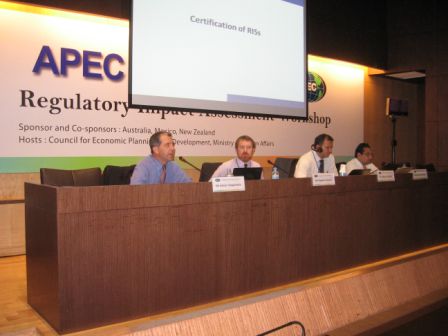
In a previous post (November 2011) this blog reported action by APEC to strengthen good regulatory practices, following the the Honolulu declaration, to assist member economies establish closer economic and trade relations.
In 2012, under the general objective of reinforcing "regulatory coherence" as listed as a priority in the Honolulu declaration, APEC implemented a capacity building project to conduct regulatory impact analysis (RIA) training for APEC developing economies. The project, developed by Australia, and co-sponsored by Australia, Mexico, New Zealand and the Russian Federation, involved a series of training courses and workshops in interested developing economies, aimed at senior economic ministry and regulatory officials. For background, see 2011 NZ proposal to APEC. The first training course was provided by the Australian Office of Best Practice Regulation, with assistance from Mexico and New Zealand, to approximately 60 Russian officials on 9 and 10 February in Moscow. Subsequently, New Zealand provided training to Thailand and Malaysia, Mexico provided training to Chile and Peru, and Australia provided training to the Philippines. In the last two weeks of August, Australia, New Zealand and Mexico jointly provided training to Hong Kong and Chinese Taipei (see attached photo), and conducted an information exchange with China. Australia and New Zealand then conducted a workshop on regulatory impact analysis in Vietnam. For a more recent expression of this APEC policy, see Kazan (Russia) meeting of APEC ministers in charge of Trade (June 2012).
08 September 2012
Template for regulatory reforms (ASEAN)
According to an ASEAN Korea Centre news item, "ASEAN is moving towards creating a template that would institutionalize regulatory reforms that would guide the region in its trade negotiations with other regional trade partners as the ten-member states fully integrate their economies by 2015."
This template would serve as ASEAN's guiding principles when they negotiate for other regional trade deals or the so-called ASEAN + 3.
So far, ASEAN has entered into regional FTA deals including China, EU, Japan, US, Australia-New Zealand, India, among others. On top of that, individual ASEAN members also conduct their own bilateral FTAs with other trading partners. These FTAs are no longer governed by ASEAN rules.
But this guiding principle will not supplant existing ASEAN agreements but rather broaden the economic reach of ASEAN as it seeks to expand trade and investments through regional FTAs.
In July this year, the Philippines hosted the first ASEAN Regulatory Reform Symposium for ASEAN (ARRS) integration in preparation for the ASEAN full economic integration or the ASEAN Economic Community (AEC) by 2015.
This template would serve as ASEAN's guiding principles when they negotiate for other regional trade deals or the so-called ASEAN + 3.
So far, ASEAN has entered into regional FTA deals including China, EU, Japan, US, Australia-New Zealand, India, among others. On top of that, individual ASEAN members also conduct their own bilateral FTAs with other trading partners. These FTAs are no longer governed by ASEAN rules.
But this guiding principle will not supplant existing ASEAN agreements but rather broaden the economic reach of ASEAN as it seeks to expand trade and investments through regional FTAs.
In July this year, the Philippines hosted the first ASEAN Regulatory Reform Symposium for ASEAN (ARRS) integration in preparation for the ASEAN full economic integration or the ASEAN Economic Community (AEC) by 2015.
23 July 2012
ASEAN holds first RR symposium
Today ASEAN convened its first Regulatory Reform Symposium (ASEAN ARRS) as part of ongoing efforts towards regional economic integration by 2015. The invitation by the Philippine to host the ARRS was accepted during the 20th High Level Task Force on ASEAN Economic Integration meeting in Jakarta last year. The symposium aims to identify key challenges in policy formulation and address the gaps to achieve a more comprehensive regulatory reform program for specific sectors and industries.
Both supply chain connectivity and logistics are heavily affected by regulations that cut across the integration pillars. The region works to set up a single market and production base, a competitive economic region, equitable economic development, and integration into the global economy by 2015.
Both supply chain connectivity and logistics are heavily affected by regulations that cut across the integration pillars. The region works to set up a single market and production base, a competitive economic region, equitable economic development, and integration into the global economy by 2015.
21 July 2012
Homeless asked for permanent address (Malaysia)
To give it an occasional lighter touch, this blog reports some of the worst cases of red tape found on the web. This one is from Kuala Lumpur where volunteers working for several non-governmental organisations (NGOs) and corporate companies to help the homeless in the city, say the current government bureaucracy in the healthcare, registration department and other agencies require a permanent address for the recipient before aid can be granted, even if he/she is homeless. See more on the Star online article.
06 July 2012
Indian PM outlines plan for inclusive growth
Under the title « Government keen to cut red tape », a leading Indian newspaper partnered with the Wall Street Journal reports that PM Singh outlined his policy to preserve growth, avoid that “the fruits of an open economy (will) be increasingly captured by fewer people, and attract FDI. The paper comments: “The government has, in recent months, come under attack for keeping key policy reforms relating to foreign investment in organized retail and insurance in limbo, and failing to make headway in implementing changes in taxation. Rating agencies Standard and Poor’s and Fitch have downgraded the outlook on India’s sovereign rating, citing slowing economic growth, high deficits and policy inaction.”
The PM now wants to renew the anti-red tape drive: “We will…work towards improving the response time of government to business proposals, cut down infructuous procedures, and make India India
It will however take more than political declarations to sort out the Indian bureaucracy, as pointed out by a Forbes India article today.
13 June 2012
Red tape on death (India)
Google news yields many colorful anecdotes about the excesses of red tape around the world making entertaining, and sometimes useful, reading. Such is the case of the Court judgment in Chennai (India) condemning a city council for refusal to register a death on the grounds that the cause of death was not clear enough.
In a helpful report, the Times Of India article summarizes the legal reasoning upheld by the judge, who criticised the local authority for driving the citizen "from pillar to post". Such ultra vires attitudes are unfortunately far too common, as highlighted by the "I paid a bribe" campaign already reported here.
In a helpful report, the Times Of India article summarizes the legal reasoning upheld by the judge, who criticised the local authority for driving the citizen "from pillar to post". Such ultra vires attitudes are unfortunately far too common, as highlighted by the "I paid a bribe" campaign already reported here.
09 April 2012
Fascinating: "I paid a bribe" world movement
How can citizens who do not have the luck to live in a (relatively) developped and corruption-free world react to the daily pressure from officials to be paid for services, such as registration of a birth or a marriage, admission to hospital, are normally free. This article from the NY Times reports the appearance of websites in several countries that denounce petty bribery, giving horrifying practical illustrations:
- The cost of claiming a legitimate income tax refund in Hyderabad, India? 10,000 rupees.
- The going rate to get a child who has already passed the entrance requirements into high school in Nairobi, Kenya? 20,000 shillings.
- The expense of obtaining a driver’s license after having passed the test in Karachi, Pakistan? 3,000 rupees.
The original ipaidabribe.com was created in August 2010 to collect anonymous reports of bribes paid, bribes requested but not paid and requests that were expected but not forthcoming and already comprises some 15,000 contributions. Others have since been set up in other countries such as China and Kenya.
23 March 2012
Where to start with regulatory reform (Myanmar)
An interesting article examines the relevance of regulatory reform for emerging economies. The specifics of the Myanmar situation do not obscure for us more general lessons applicable to many other countries. Here are some highlights to make you want to read the article in full:
"The technocratic chicken or egg? Myanmar suffers from the proverbial chicken or the egg problem: the country needs a sound regulatory and economic base to induce, enable and create technocrats to add value to Myanmar's rudimentary and primary industry-focused political and economic system, but Myanmar lacks the technocrats to actually create a friendly environment for technocrats. Since 1988, military leaders have intentionally weakened Burmese education, spreading out university campuses to prevent the agglomeration of students necessary for proper activism and civil disobedience."
The author also draws up a list for priority areas for change, where regulations must be reformed: "Extensive work is required on drafting sophisticated new laws. As of this writing, Myanmar has a seriously outdated foreign investment law (FDI law), outdated food and drug laws, outdated private enterprise and banking laws, no securities laws, no environmental laws, no mergers and acquisitions (M&A) laws, no derivatives and no commodities exchanges. There are no or very weak environmental, competitive, judicial, legislative, financial, labour, securities, banking and corporate regulatory institutions. So even if there were appropriate laws in place, enforcement and oversight would be all but impossible. Bribery and corruption are reported to be widespread in the country."
Action is urgently required, the article pleads for regulatory reform on the basis that it can prevent a new form of colonialism by foreign companies "carving up the country without regard to environmental, labour, displacement, human rights or domestic capacity issues."
"The technocratic chicken or egg? Myanmar suffers from the proverbial chicken or the egg problem: the country needs a sound regulatory and economic base to induce, enable and create technocrats to add value to Myanmar's rudimentary and primary industry-focused political and economic system, but Myanmar lacks the technocrats to actually create a friendly environment for technocrats. Since 1988, military leaders have intentionally weakened Burmese education, spreading out university campuses to prevent the agglomeration of students necessary for proper activism and civil disobedience."
The author also draws up a list for priority areas for change, where regulations must be reformed: "Extensive work is required on drafting sophisticated new laws. As of this writing, Myanmar has a seriously outdated foreign investment law (FDI law), outdated food and drug laws, outdated private enterprise and banking laws, no securities laws, no environmental laws, no mergers and acquisitions (M&A) laws, no derivatives and no commodities exchanges. There are no or very weak environmental, competitive, judicial, legislative, financial, labour, securities, banking and corporate regulatory institutions. So even if there were appropriate laws in place, enforcement and oversight would be all but impossible. Bribery and corruption are reported to be widespread in the country."
Action is urgently required, the article pleads for regulatory reform on the basis that it can prevent a new form of colonialism by foreign companies "carving up the country without regard to environmental, labour, displacement, human rights or domestic capacity issues."
22 November 2011
India: senior businessman calls for regulatory oversight body
Another well documented article dated 13 November completes the picture presented by a recent post. By the same author (a former chairman of the Telecoms authority) it calls for the establishment of an independent oversight body such as exists in the UK an other countries. This article summarizes the Indian RR approach and argues that the stock-taking of existing acts, which has been conducted in India in the past, should be viewed as only the first step of regulatory reforms. Now "it was expected that an institutional mechanism would be put in place towards producing high-quality regulations based on the touch-stone principles of legitimacy, efficacy, transparency and accountability. To accomplish this enormous task, an oversight body to provide structured directions to the regulatory regime of the country is needed. Such a body already exists in many developed countries.
In order for it to be effective, it should be located in the prime minister's office, vested with powers to independently coordinate, review and approve all regulatory policies and thus function as a focal point for quality regulation and good regulatory governance in the country. Such an oversight institution would provide a comprehensive regulatory management system through which regulations are developed, enforced and adjudicated, thus supporting the broader objectives of efficiency, transparency and accountability in governance.
Accountability of regulators cannot be addressed by a single piece of legislation. In the United Kingdom, there is a Committee of Parliamentarians which monitors the functioning of various regulators. Perhaps this can be experimented with in our country as the first immediate step for regulatory oversight."
In order for it to be effective, it should be located in the prime minister's office, vested with powers to independently coordinate, review and approve all regulatory policies and thus function as a focal point for quality regulation and good regulatory governance in the country. Such an oversight institution would provide a comprehensive regulatory management system through which regulations are developed, enforced and adjudicated, thus supporting the broader objectives of efficiency, transparency and accountability in governance.
Accountability of regulators cannot be addressed by a single piece of legislation. In the United Kingdom, there is a Committee of Parliamentarians which monitors the functioning of various regulators. Perhaps this can be experimented with in our country as the first immediate step for regulatory oversight."
08 November 2011
Indian RR: poor results
Though an impressively dynamic economy, India still does not offer a competitive business environment. According to the 2012 Doing Business ranking, though present in the 30 economies that improved the most over time, India still ranks low overall , with its rank improving marginally from 139 to 132 between the 2011 and 2012 reports. On the reform undertaken in India, the 2012 report said, “When India dismantled a strict licensing regime controlling business entry and production the benefits were greater in states that had more flexible labour regulations”.
These results point at insufficient results fromRegulatory Reform which, though on the books since the late 1990's seems to be slow in delivering, as reported on this blog.
Today, in awell documented article is published on India Express, a former chairman of Public Interest Foundation, gives figures about how the Indian legal corpus has been streamlined, but not sufficiently. Texts remain from the colonial days. He also calls for a framework to channel regulatory activities ("regulate the regulators.")
These results point at insufficient results fromRegulatory Reform which, though on the books since the late 1990's seems to be slow in delivering, as reported on this blog.
Today, in awell documented article is published on India Express, a former chairman of Public Interest Foundation, gives figures about how the Indian legal corpus has been streamlined, but not sufficiently. Texts remain from the colonial days. He also calls for a framework to channel regulatory activities ("regulate the regulators.")
Subscribe to:
Posts (Atom)