(Yonhap press release) "The Australian Embassy in Seoul on Friday (13 March) hosted a forum on regulatory reform and deregulation with the South Korean government in a bid to explore ways for cooperation in these areas, officials said.
The one-day forum titled the "Best Practice Regulation Workshop" came as Seoul and Canberra seek to boost cooperation in the field of regulatory reforms with a free trade agreement between South Korea and Australia (KAFTA) going into effect late last year.
"Services and investment are important parts of KAFTA, but they cannot reach their full potential unless the regulatory environment improves," Bill Paterson PSM, the Australian ambassador to Seoul, said at the opening of the forum.
"Predictability, transparency, consultation, consistent application, and cutting red-tape are essential and both our governments are committed to achieving a more business friendly regulatory environment," he added.
Kang Young-chul, deputy minister for regulatory reform, also said that "drastic reform is necessary for the success of regulatory reforms," adding that South Korea and Australia will continue to carry out cooperation in this sector.
South Korea said that it will scrap more than 100 administrative rules cited by local companies for hindering businesses as it seeks to prod more companies into increasing investment to jump-start the local economy.
Australia is in the process of reducing tape worth $1 billion every year in its drive for deregulation, the embassy said."
Showing posts with label Aus/NZ. Show all posts
Showing posts with label Aus/NZ. Show all posts


22 October 2013
Culture change for regulators (Australia)
The Australian Productivity Commission release a research report earlier this month on "Regulator Engagement with Small Business" according to which "Regulators can do more to reduce the compliance and enforcement burdens they impose on small businesses. The Commission argues that regulators should ensure they understand how regulation impacts on small business and keep the compliance capacity of small businesses at the forefront of their minds." A regulator's culture and attitude towards business should include the following improvements:
- Regulators should adopt a multi-channel approach to communicating with small businesses with a focus on the brevity, clarity and accessibility of information.
- Compliance and enforcement strategies should be proportionate to risks posed to communities and facilitate voluntary compliance.
- Regulators should commit publicly to target timeframes for key processes, report on their performance in meeting targets, and consider other measures to improve timeliness.
- Regulators should have access to a sufficient range of enforcement tools and be resourced to do their job effectively, to avoid the shifting of direct and indirect costs onto businesses.
12 April 2013
Red Tape Blitz picks up momentum (Australia)
The Australian Government's ComLaw site publishes the "Attorney-General's (Spent and Redundant Instruments) Repeal Regulation 2013" which includes lists totalling 1000 regulations and other instruments repealed, in what observers call a "red tape blitz." Regulations repealed include the National Handgun Buyback Regulations 2003, which governed the purchase of outlawed weapons and other obscure instruments including marriage regulations that referred to unmarried men and women as ‘spinsters’ and ‘bachelors’. The oldest of the repealed laws was made in 1967. According to Attorney-General, the program aims to delete more than 12,000 this year. Minister for Finance and Deregulation, P. Wong indicated that the repeals followed amendments made by the Legislative Instruments Amendment (Sunsetting Measures) Act 2012, with the repeal instrument registered on the Federal Register of Legislative Instruments now taking full effect. "The latest repeals were in addition to reforms through the COAG Seamless National Economy agenda, which the Productivity Commission had estimated would save businesses billions of dollars each year when fully implemented." For background see previous Sept 2012 post, and for comments, Public Service News article.
04 March 2013
Red Tape on Charities (Australia)
One of the Australian Charities and Not-for-profits Commission's (ACNC's) statutory objects is to 'promote the reduction of unnecessary regulatory obligations on the sector' which comprises 56,000 charities. ACNC is an independent national regulator, set up in December 2012, primarily to reduce red tape by creating a “one-stop shop”. But since then, critics have said (according to the Financial Review) that the new regulator would be increasing, not reducing, burdens by creating an extra layer of bureaucracy; its action would b e limited by non-recognition of its status at sub-national level as it had been "established without an agreement from the states and territories to harmonise their laws governing charities and non-profits." Reacting to these claims, the Federal Finance Minister announced on 4 March that updated Grant Guidelines to be released in June 2013 will help reduce duplication and the time taken to provide information to federal government bodies and the PM has announced that she would write to state and territory leaders asking them to match the federal commitment (see News.com.au).
19 January 2013
Victoria (AUS) appoints red tape commissioner
As reported by Property Observer Melbourne yesterday, Australia's first red tape commissioner has beenappointed in Victoria and will start compiling a list of problem areas to target and bring to the state's government's attention.
Already in October, the Federal Government has appointed the first small business commissioner.
Victoria has a target to reduce red tape by 25% – if this experiment proves useful, other states could follow with similar appointments
19 December 2012
New RR package (Australia)
Earlier this month, the Australian government announced a package of regulatory reform measures to improve regulatory performance. As part of the reform package the Government has agreed to;
- adopt a two-stage process for developing regulation impact statements (RISs);
- strengthen the role of annual regulatory plans (ARPs); and
- encourage better and more informed stakeholder consultation.
The Office of Best Practice Regulation will be preparing revised guidance material to reflect the new arrangements.
The current arrangements for Regulatory Impact Analysis are set out in the Government's Best Practice Regulation Handbook and commenced operation on 1 July 2010. The Government committed to reviewing the framework within two years. The Minister for Finance and Deregulation agreed in December 2011 that an independent review be conducted of the arrangements. The Review was conducted by Mr Robert Milliner and Mr David Borthwick AO PSM and was handed to the Minister on 20 April 2012. On 11 October 2012 the Government released a Preliminary Response to the RIA Review for four weeks public consultation. The results of the consultation have informed the Final Response. For more, there is also a media release.

24 October 2012
Best Practice Regulation annual compliance report (Australia)
On 17 October 2012, the Office of Best Practice Regulation (OBPR) released its annual compliance report, the Best Practice Regulation Report 2011-12. This report is the OBPR's independent assessment of compliance with the Australian Government and Council of Australian Governments (COAG) best practice regulation requirements. Essentially it answers the question whether a Regulation Impact Statement was prepared for the decision and if it was published. It also includes information about post-implementation reviews.
The 2011-12 report shows an increase in compliance with the Australian Government best practice regulation requirements. The number of non-compliant proposals fell from 16 to 9, and compliance at the decision-making stage increased in percentage terms from 75 per cent to 88 per cent. No agency had more than one example of non-compliance with the best practice regulation requirements.
The Australian Government prepared RISs on a broad range of issues including Australia’s negotiating framework regarding bluefin stock, regulatory changes to facilitate the rollout of the NBN and Australia’s plan for a clean energy future. Australian Government non-compliant proposals included measures to address problem gambling, tobacco plain packaging and revised export control orders for the live cattle trade.
The number of Prime Minister’s ‘exceptional circumstances’ exemptions granted decreased from 14 in 2010-11 to 5 in 2011-12. Proposals granted exemptions included reforms to the superannuation system and extending Telstra retail price controls to June 2014 (from our Federal correspondent).
The 2011-12 report shows an increase in compliance with the Australian Government best practice regulation requirements. The number of non-compliant proposals fell from 16 to 9, and compliance at the decision-making stage increased in percentage terms from 75 per cent to 88 per cent. No agency had more than one example of non-compliance with the best practice regulation requirements.
The Australian Government prepared RISs on a broad range of issues including Australia’s negotiating framework regarding bluefin stock, regulatory changes to facilitate the rollout of the NBN and Australia’s plan for a clean energy future. Australian Government non-compliant proposals included measures to address problem gambling, tobacco plain packaging and revised export control orders for the live cattle trade.
The number of Prime Minister’s ‘exceptional circumstances’ exemptions granted decreased from 14 in 2010-11 to 5 in 2011-12. Proposals granted exemptions included reforms to the superannuation system and extending Telstra retail price controls to June 2014 (from our Federal correspondent).
23 October 2012
Australia perfects RIA requirements
On 11 October 2012, the Australian Government announced preliminary changes to the Australian Government RIA requirements, as a response to an independent review of the RIA process filed in April 2012. The major proposed change would be the introduction of a two stage RIS process, with an options paper to be followed by a details RIS. This is intended to encourage greater consultation by Government agencies.
The independent report was critical that some Ministers and agencies are not sufficiently committed to the RIA requirements, and recommends that the Government re-endorse and re-commit to the RIA process. The Government proposes to accept this recommendation.
The Government is holding a four week consultation period on the proposed changes with a view to announcing its final response by the end of 2012 (from our AUS federal correspondent.)
The independent report was critical that some Ministers and agencies are not sufficiently committed to the RIA requirements, and recommends that the Government re-endorse and re-commit to the RIA process. The Government proposes to accept this recommendation.
The Government is holding a four week consultation period on the proposed changes with a view to announcing its final response by the end of 2012 (from our AUS federal correspondent.)
20 September 2012
Australian Parliament cleans up stock of legislation
On 13 September 2012, the Australian Parliament passed legislation to remove about 12,000 regulations from the statute books. The Legislative Instruments Amendment (Sunsetting Measures) Act 2012 (according to MoF media release) enables thousands of unnecessary regulations to be removed in an efficient, streamlined process, without the need to repeal them one-by-one. These regulations are described as spent and redundant regulations.
A second set of amendments provides for a more efficient repeal or 'sunsetting' of regulations after 10 years, and facilitates reviews of those regulations, for example, by looking at regulations across a particular industry sector as a whole. The Act provides that the sunsetting dates for regulations are staggered, so that not all reviews of sunsetting regulations are due at the same time. This will enable the review of sunsetting regulations to be conducted in a more efficient and effective manner (from our Australian federal correspondent).
A second set of amendments provides for a more efficient repeal or 'sunsetting' of regulations after 10 years, and facilitates reviews of those regulations, for example, by looking at regulations across a particular industry sector as a whole. The Act provides that the sunsetting dates for regulations are staggered, so that not all reviews of sunsetting regulations are due at the same time. This will enable the review of sunsetting regulations to be conducted in a more efficient and effective manner (from our Australian federal correspondent).
18 September 2012
Regulatory "coherence" helps regional economic integration (APEC)
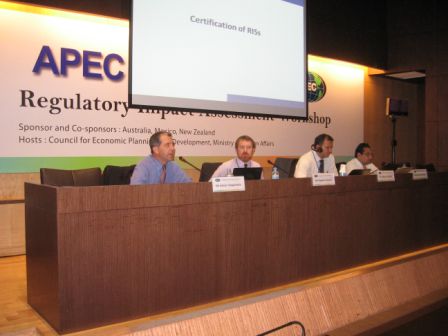
In a previous post (November 2011) this blog reported action by APEC to strengthen good regulatory practices, following the the Honolulu declaration, to assist member economies establish closer economic and trade relations.
In 2012, under the general objective of reinforcing "regulatory coherence" as listed as a priority in the Honolulu declaration, APEC implemented a capacity building project to conduct regulatory impact analysis (RIA) training for APEC developing economies. The project, developed by Australia, and co-sponsored by Australia, Mexico, New Zealand and the Russian Federation, involved a series of training courses and workshops in interested developing economies, aimed at senior economic ministry and regulatory officials. For background, see 2011 NZ proposal to APEC. The first training course was provided by the Australian Office of Best Practice Regulation, with assistance from Mexico and New Zealand, to approximately 60 Russian officials on 9 and 10 February in Moscow. Subsequently, New Zealand provided training to Thailand and Malaysia, Mexico provided training to Chile and Peru, and Australia provided training to the Philippines. In the last two weeks of August, Australia, New Zealand and Mexico jointly provided training to Hong Kong and Chinese Taipei (see attached photo), and conducted an information exchange with China. Australia and New Zealand then conducted a workshop on regulatory impact analysis in Vietnam. For a more recent expression of this APEC policy, see Kazan (Russia) meeting of APEC ministers in charge of Trade (June 2012).
20 August 2012
Austalian government simplifies licenses
The Australian governement announced last week plans to streamline a number of licensing schemes for plumbing and gas fitting, property, refrigeration and air-conditioning occupational licensing thereby providing an estimated annual benefit of more than $86 million to the national economy and boosting labour mobility.
The minister in charge released Consultation Regulation Impact Statements for each of the occupational areas saying the proposal offered benefits to licence holders and delivers on a key plank of the Council of Australian Governments' commitment to regulatory reform.
The introduction of one set of national licences for key occupations will make it easier for businesses and individuals to operate across state and territory borders and improve business productivity. A central licensing body will administer one set of requirements for each of the licensed occupations.
The minister in charge released Consultation Regulation Impact Statements for each of the occupational areas saying the proposal offered benefits to licence holders and delivers on a key plank of the Council of Australian Governments' commitment to regulatory reform.
The introduction of one set of national licences for key occupations will make it easier for businesses and individuals to operate across state and territory borders and improve business productivity. A central licensing body will administer one set of requirements for each of the licensed occupations.
01 August 2012
Australian Company Directors call for deregulation
The Australian Institute of Company Directors (a business lobby) has just released a 76-page ''working paper'', titled Business Deregulation: A call to action, along with a ''discussion document'', media release and a request for 'stakeholders' to lodge a submission on the topic.
One of the questions asked in the discussion document is: ''Are you aware of Australian regulations which are redundant, poorly designed or excessive?''
The AICD's initiative comes after the Productivity Commission released a full report last December on Identifying and Evaluating Regulation Reforms and published numerous reports over the past five years on reducing the burden of unnecessary legislation.
One of the questions asked in the discussion document is: ''Are you aware of Australian regulations which are redundant, poorly designed or excessive?''
The AICD's initiative comes after the Productivity Commission released a full report last December on Identifying and Evaluating Regulation Reforms and published numerous reports over the past five years on reducing the burden of unnecessary legislation.
Link between BR and economic performance (NZ)
A press release published today by the New Zealand Government provides fresh evidence that well managed regulatory systems can bring improvements in the overall economic performance of a country. It reports the main findings of a preliminary assessment of national regulations, incoporated in an official publication: Best Practice Regulation Model: Principles and Assessments. According to the finance minister, "this new model ... considers whether each regime gives appropriate weighting to factors that can help improve economic performance – competition, innovation, exports, compliance costs and trade and investment openness" and can suggest areas for further simplification.
13 June 2012
Australian results in deregulation
An AAP despatch dated of today, summarizes the Australian governement's recently released annual update on its deregulation agenda. The report - "Streamlined, Effective, Productive: an annual update on the Australian government deregulation agenda" - considers the regulatory review and reform measures of 2011 and 2012 that aimed to improve regulations for business, the community, consumers and the environment.The report details the partnership between the Commonwealth and the states and territories under a program involving 27 reforms due for completion by December 2013. Other measures include recent federal regulation for more efficient inspection of meat exports, a proposed new standard definition of a flood for insurance and the development of new pollution standards for light vehicles. The report noted figures from the Productivity Commission which showed 17 of the 27 major Commonwealth-state regulatory reforms could boost the nation's economic output by $6 billion a year.
20 April 2012
Red Tape Taskforce created in Queensland
A Red Tape Reduction Taskforce has just been set up in Queensland. It will report by mid July to the state government "about what regulations can be done away with," whether they come from the state or the local level, though most texts are expected to come from the state.
The taskforce brings together council representatives as well as experts in planning, building, environment health and licensing. Its focus will be to identify red tape and regulation that can be removed to help small business. The objective is "to cut red tape by 20 per cent ... or some 18,000 pages."
For background, see the brochure from the Queensland Chamber of Commerce and Industry. A September 2011 report from the Productivity Commission gives an overview of the regulatory role of local government (some 580 entities in 8 states).
The taskforce brings together council representatives as well as experts in planning, building, environment health and licensing. Its focus will be to identify red tape and regulation that can be removed to help small business. The objective is "to cut red tape by 20 per cent ... or some 18,000 pages."
For background, see the brochure from the Queensland Chamber of Commerce and Industry. A September 2011 report from the Productivity Commission gives an overview of the regulatory role of local government (some 580 entities in 8 states).
23 March 2012
Australian (new) Business Advisory Forum
The involvement of business in orienting regulatory reform can take many forms. Earlier this month, the Australian Government announced the creation of a Business Advisory Forum to advise on deregulation, according to the official press release. Business leaders of the nation’s biggest companies will join state and territory leaders in a new deregulation dialogue . Senior business figures on this Forum will have two main roles:
• To advise Governments on how best to coordinate and progress the remaining areas of competition and regulatory reform; and
• To nominate new areas of regulatory reform that will help lift productivity and drive investment, therefore growing businesses and creating new jobs.
Small business will also be directly represented on the Forum, given smaller firms often disproportionately feel the impact of regulatory burdens.
The forum will work alongside the Council of Australian Governments to identify regulations that are hurting economic activity across state boundaries, such as inconsistent standards for tradespeople who move interstate , to unlock a combined $4 billion in productivity gains.
• To advise Governments on how best to coordinate and progress the remaining areas of competition and regulatory reform; and
• To nominate new areas of regulatory reform that will help lift productivity and drive investment, therefore growing businesses and creating new jobs.
Small business will also be directly represented on the Forum, given smaller firms often disproportionately feel the impact of regulatory burdens.
The forum will work alongside the Council of Australian Governments to identify regulations that are hurting economic activity across state boundaries, such as inconsistent standards for tradespeople who move interstate , to unlock a combined $4 billion in productivity gains.
Comments in the press highlight the need for the Governement to make peace with the business world after several key reforms meeting difficulties. The Australian recalls that "the creation of the forum, after extensive lobbying by business, follows a report last month from the Council of Australian Governments' Reform Council, which warned that 12 key reforms were at risk including harmonised occupational health-and-safety laws, a national trade licensing system, a nationally consistent approach to the imposition of personal criminal liability on company directors, national regulation of the legal profession and energy reforms. " See also Sydney Morning Herald for more comments.
23 January 2012
South Australia Red Tape report
The South Australian Government (Competitiveness Council) released a report on action taken in 2010-2011 to reduce red tape for business at the state level. The programme sets out to cut administrative burdens by $150 million a year. The first tranche finished $18 million ahead of target and the second (to be completed by April 2012) is ahead of schedule.
Regulatory costs to the broader community are also to be addresse. Also of note at the South Australian level: in December 2010, a Better Regulation Handbook was issued to all agencies in order to improve transparency in reviewing and designing regulation. (tip from S. Trnka).
Regulatory costs to the broader community are also to be addresse. Also of note at the South Australian level: in December 2010, a Better Regulation Handbook was issued to all agencies in order to improve transparency in reviewing and designing regulation. (tip from S. Trnka).
27 September 2011
Australia scrutinises evaluation of reform
An Australian active member of our network draws our attention to an interesting technical document issued by the Productivity Commission on 23 September. It is a "discussion draft." to support on-going work on Identifying and Evaluating Regulatory Reforms, currently one of the most relevant issues in RR (see OECD conference in Madrid on a very close topic). It contains a considerable amount of in-depth analysis of methods for identifying and evaluating regulatory reforms, in both the main report and the very rich appendices.
Australia is part of a small group of countries that has chosen the "productivity" approach rather than focus on "competitiveness" (as Ireland, among others, does). In the opinion of this blogger, productivity makes more sense economically, is better rooted in theory, when dealing with the dynamics of factors of production.
The site of the Australian ministry of finance contains some interesting insights into the history and relevannce of productivity in the national context.
08 September 2011
NZ moves to "Reducing Regulation"
(From Daniel T.) In a report published today, the New Zealand government reports on its activity since November 2008 to implement its 2009 regulatory policy entitled "Better Regulation, Less Regulation." After a brief presentation of concepts, including a list of seven updated principles, the report lists both changes already implemented as well as those approved by Cabinet and being carried out. It sets out the expected impacts of regulatory changes on businesses and citizens, although the full impacts and costs were not yet fully calculated. "Case studies" in separate boxes help understand the nature of the measures, which are listed under headings that speak volumes: removing requirements, streamlining processes, increasing flexibility, taking a risk-based approach, market expansion, closely supervising compliance costs.Some of the measures are being enacted via an (omnibus) Regulatory Reform Bill, while a "revocations" act repeals a number of obsolete regulations. All in all, efficiency and innovation from the land of the Kiwi (not only good rugby).
05 July 2011
Queensland (Australia) appoints business commissioner
After Victoria and NSW, Queensland makes news with the appointment of a Business Commissioner, an equivalent to the US "regulatory czar," Cass Sunstein who has recently been in the news with a statement on "job-killing" regulations. Mr Sunstein has been labeled the "most dangerous man in America" by television and radio commentator Glenn Beck. He has suggested that government recognition of marriage be discontinued (Wikipedia article.)
The Queensland Business Commissioner's job description is quite interesting: he/she will
· Lead the program to cut red tape across government
· Work with business representative organisations;
· Advise government agencies on best practice in regulation and recommend timelines for government's decision making processes; and
. make sure that before new laws are introduced, government departments will require a Regulatory Assessment Statement - showing that "the point of regulation outweighs the imposition of doing it".
The Queensland Business Commissioner's job description is quite interesting: he/she will
· Lead the program to cut red tape across government
· Work with business representative organisations;
· Advise government agencies on best practice in regulation and recommend timelines for government's decision making processes; and
. make sure that before new laws are introduced, government departments will require a Regulatory Assessment Statement - showing that "the point of regulation outweighs the imposition of doing it".
Subscribe to:
Posts (Atom)